IBAN Check Digit Explained: How MOD-97 Catches Typos Before They Cost You
A beginner-friendly guide to IBAN check digits: what they are, why they exist, and how the MOD-97 algorithm detects errors without contacting a bank.

Founder, ibanchecker.cash
Every IBAN contains two digits that look unremarkable but do a remarkable job: they are calculated from the rest of the account number and can detect most typing mistakes before a payment is ever sent. These are the IBAN check digits, and they are computed using an algorithm called MOD-97. This beginner-friendly guide explains what check digits are, why they matter, and how they work, without requiring a maths degree.
What Exactly Are IBAN Check Digits?
Take the UK IBAN: GB29 NWBK 6016 1331 9268 19
The two characters directly after the country code, 29 in this example, are the check digits. They occupy positions 3 and 4 in every IBAN, without exception.
Check digits are not chosen by the bank. They are calculated mathematically from all the other characters in the IBAN. Change even a single digit elsewhere in the account number and the check digits will no longer match, the IBAN becomes invalid.
You can verify check digits instantly with the ibanchecker.cash validator.
Why Do Check Digits Exist?
Bank account numbers are long strings of digits. People mistype them. A single transposed digit, writing 53 instead of 35, could send money to a completely different account. Before IBANs, if you made a typo in an account number, the payment either bounced (costing fees and time) or, worse, landed in someone else's account.
The check digit system solves this by giving every IBAN a built-in self-test. Any system, your bank's software, a payment app, an online validator, can check the digits without contacting the recipient's bank. The error is caught immediately, before the payment enters the banking network.
How Does the MOD-97 Check Work in Plain English?
The algorithm that calculates and verifies check digits is called MOD-97-10, defined in the ISO 13616 standard. Here is what it does, step by step, without any confusing notation:
- Rearrange the IBAN. Move the first four characters (the country code and check digits) to the end. For
GB29NWBK60161331926819, this givesNWBK60161331926819GB29. - Replace letters with numbers. Each letter becomes a two-digit number: A=10, B=11, C=12 … Z=35. So
N=23,W=32,B=11,K=20,G=16,B=11. The string becomes a long chain of digits. - Divide by 97 and check the remainder. Take that enormous number, which can be 30+ digits long, and divide it by 97. If the remainder is exactly 1, the IBAN is valid. Any other remainder means the IBAN contains an error.
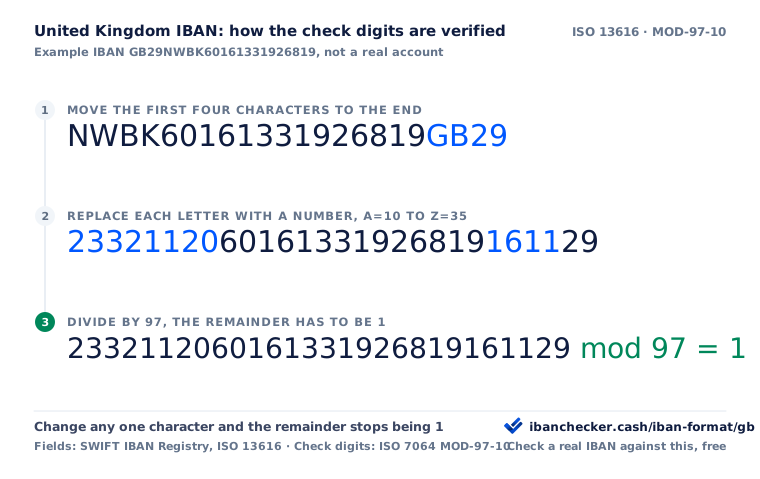
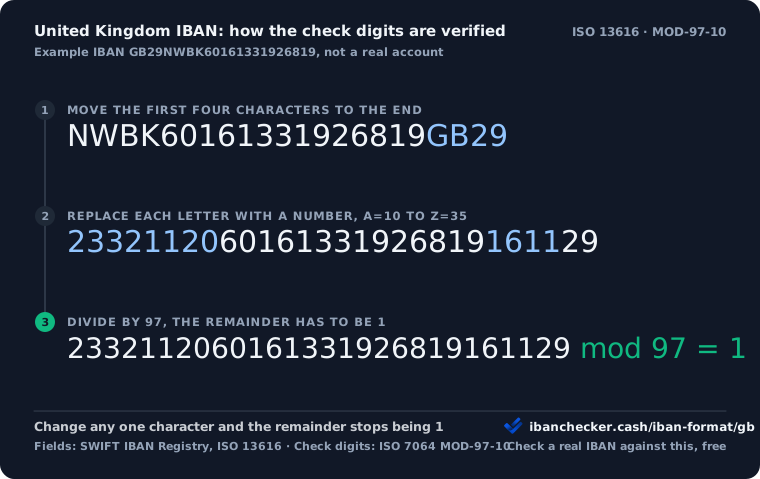
The check digits are chosen precisely so that a correctly formed IBAN always gives a remainder of 1. It's a mathematical guarantee built into the number itself.
What Kind of Errors Do Check Digits Catch?
The MOD-97 algorithm is designed to detect the most common human errors:
- Single-digit typos, typing
7instead of1anywhere in the IBAN. MOD-97 catches all single-digit substitutions. - Transposed adjacent digits, swapping
35to53. MOD-97 catches all adjacent transpositions. - Twin errors, changing
11to99. These are detected too.
Overall, MOD-97 catches over 97% of all random single-character errors, which is where the name comes from. The remaining cases are statistically very rare.
What Errors Can Check Digits NOT Catch?
Check digits have limits. They verify that the IBAN is mathematically valid, not that the account actually exists or belongs to the right person.
- Valid-but-wrong IBAN, If you accidentally type an IBAN that happens to pass the check digit test but belongs to a different account, the payment will go to the wrong person. This is rare but possible.
- Fraud, Someone deliberately giving you a valid IBAN that they control instead of the intended recipient's account. Check digits cannot detect intentional deception.
- Non-existent accounts, An IBAN can pass the MOD-97 test even if no account with that number exists. The bank will reject the payment at a later stage, but the check digit step will pass.
This is why check digit validation is a first filter, not a complete solution. For high-value payments, additional verification steps, such as checking against a known beneficiary or using a bank lookup service, are recommended.
Is the Check Digit the Same as the BBAN?
No. The check digits (positions 3–4) are a property of the IBAN as a whole. The BBAN (Basic Bank Account Number) is the country-specific portion that follows the check digits. The BBAN often contains its own internal validation (for example, French IBANs include a separate clé RIB check), but these are different from the IBAN check digits and follow country-specific rules.
To learn more about the BBAN, see What Is a BBAN?
How Can I Verify an IBAN's Check Digits?
You don't need to do the maths yourself. The ibanchecker.cash validator runs the full MOD-97 check automatically. Paste any IBAN and it will tell you in under a second whether the check digits are valid, along with the country, expected length, and a breakdown of the BBAN structure.
You can also use the IBAN Format Checker to see a detailed breakdown of any IBAN's components including its check digits.
Sources & References
- ISO 7064:2003, MOD-97-10 check digit algorithm standard
- ISO 13616-1:2020, International Bank Account Number (IBAN) standard
- SWIFT IBAN Registry: Official IBAN country format specifications
Last updated: June 2026
Sending money to another country?
Wise shows the exchange rate and its fee before you send.
Partner link. If you open a Wise account through it and send money between two currencies, Wise pays ibanchecker.cash a commission; what you pay does not change. How this works
Validate an IBAN instantly
Free MOD-97 verification, bank name lookup, and SEPA status across 92 countries.
What Is an IBAN? Complete Guide to International Bank Account Numbers
Learn what an IBAN is, how it works, where it's used, and how to find your own IBAN number.
How IBAN Check Digits Work (MOD-97 Algorithm Explained)
A technical deep dive into the MOD-97-10 check digit algorithm: how it detects transcription errors and why a single dig...
IBAN vs SWIFT/BIC Code: Key Differences Explained
IBANs and SWIFT codes are both used in international payments, but they serve different purposes. Here's what each ident...
How to Read an IBAN: Country Code, Check Digits, and BBAN Explained
Every IBAN has four parts: country code, check digits, bank identifier, and account number. Learn what each section mean...